Leaked audios suggest BC governor sought deal with FBI to avoid US charges and extradition
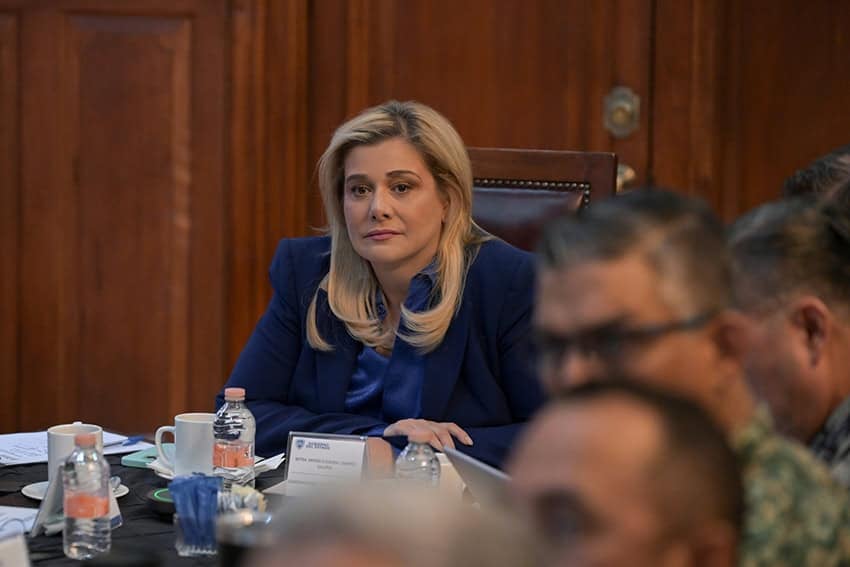
In a telephone conversation with one man identified as an “external” FBI adviser and another man identified as an FBI “special agent,” Baja California Governor Marina del Pilar Ávila Olmeda — who was stripped of her U.S. tourist visa last year — said she is willing to cooperate with U.S. authorities, apparently in order to avoid possible criminal charges in the United States and extradition to that country.
An audio recording in which Ávila speaks of her willingness to collaborate with U.S. authorities was published by the newspaper El Universal on Monday in a column by journalist Héctor de Mauleón. The column is headlined “In new audio, Marina del Pilar offers to collaborate with the FBI.”
🔴 A pesar de que la gobernadora de Baja California aseguró nunca haber buscado acuerdos privados con autoridades de Estados Unidos, una nueva revelación de @hdemauleon demuestra lo contrario.
En la grabación filtrada, se escucha a la mandataria expresar su temor por una posible… pic.twitter.com/Yisn6VcnNV
— LuisCardenasMX (@LuisCardenasMx) July 13, 2026
In one section of the recording, Ávila says: “They’re saying they’re going to charge me and file an extradition order. I’m always willing to speak about everything I know, how to help, how to cooperate. I can say what I’ve heard in security meetings.”
The governor, who represents the ruling Morena party, has confirmed the authenticity of the audio recording published by El Universal on Monday as well as another recording published by the same newspaper last month in which she expressed her willingness to “clarify anything” to U.S. authorities that needs to be clarified.

In a statement to the media, the social communication department of the Baja California government said that “the recordings disseminated correspond to fragments of a private conversation with people who introduced themselves as agents or intermediaries of U.S. authorities without formally confirming said representation.”
“During the conversation, these people set out different legal scenarios without presenting documents, identification or official requests to support their claims,” the statement said.
The Baja California government also said that the references to “cooperation and exchange of information correspond exclusively to institutional coordination on security matters that Baja California, as a border entity, maintains with the authorities of Mexico and the United States.”
The publication of the second recording comes 14 months after Ávila revealed that the United States had revoked tourist visas for her and her then-husband, Carlos Torres Torres. The governor denied any wrongdoing, saying that the revocation of her visa was “an administrative decision, not an accusation.”
Baja California governor confirms criminal probe into ex-husband
In January, Ávila confirmed that the Federal Attorney General’s Office was investigating her ex-husband, a former federal deputy, for crimes related to arms trafficking, drug trafficking and money laundering.
It was unclear what charges, if any, the 40-year-old Baja California governor could face in the United States. Asked by the FBI adviser “the charges” the governor faces or “the crime” she is accused of, a man said to be an FBI special agent responds: “I can’t discuss that in detail. That would have to be a discussion between our prosecutor and her [lawyer].”
Another Morena party governor, Rubén Rocha Moya of Sinaloa, is accused by U.S. prosecutors of drug trafficking in league with the Sinaloa Cartel.
The New York Times reported in late June that “elected officials in the country’s governing party” — including governors and members of Congress — “have been quietly offering themselves to U.S. authorities as informants against fellow party members, according to eight people involved in the conversations.”
‘A final chance’?
At the start of the most recent recording published by El Universal, a man identified by de Mauleón as an FBI special agent, speaking in English, says: “I think they’re going to offer a final last chance.”
“That was the special agent,” the FBI adviser tells Ávila in Spanish.
The special agent was referring to a “final chance” for Ávila, governor since late 2021, to cooperate with U.S. authorities before charges against her are possibly laid in the United States.
Ávila points out that she has already met with U.S. authorities.
However, the special agent says: “Essentially there is a lot of frustration right now with the U.S. government because the three meetings … were not productive.”
Ávila says she doesn’t want to have any more meetings with U.S. authorities because “they’ve behaved very badly.”
“… I haven’t seen any progress, any attention,” she says.
At one stage of the recording, Ávila questions whether she is going to be sanctioned by OFAC, the U.S. Treasury Department’s Office of Foreign Assets Control. She says she has two bank accounts in the United States. The FBI adviser responds that he doesn’t know anything about possible sanctions.
Later in the recording, the governor asks whether a U.S. prosecutor will contact her lawyer, Miami-based Michael Nadler. The FBI adviser indicates that will happen, and Ávila subsequently says she doesn’t want to cross into the United States for more meetings with U.S. authorities. She expresses her preference for meeting with U.S. authorities at a hotel rather than at the U.S. Consulate in Tijuana, the largest city in the state she governs.
Ávila also says she is privy to a lot of security information and asks whether there is anything in particular that U.S. authorities “want to know.”
García Harfuch: No indication that Ávila will provide ‘confidential information’ to US authorities
At President Claudia Sheinbaum’s Tuesday morning press conference, Security Minister Omar García Harfuch said that in the audio recording published on Monday, it cannot be “inferred” that Ávila is going to provide “confidential information” to U.S. authorities.
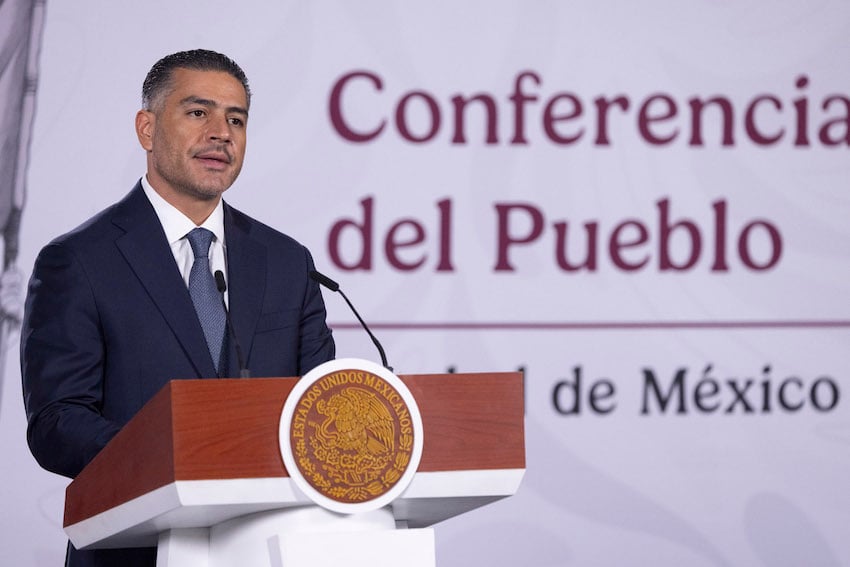
García Harfuch also said that in state security meetings, information with a high degree of “sensitivity,” whose disclosure to another authority would be concerning, is not presented or discussed.
The only things presented in such meetings — which are attended by federal, state and municipal officials — are crime statistics and information on “priority targets” and “ongoing cases,” he said.
Sheinbaum: It is not known who Ávila spoke to
Asked about the recording published on Monday, Sheinbaum noted that Ávila already provided her own explanation.
“It’s really not even known who she was speaking to,” she added.
“What we have is a telephone call that was made public by a journalist,” Sheinbaum said.
“… We don’t know who the person is. We don’t even know if he is from the U.S. authorities or not,” she said.
Sheinbaum asserted that Ávila has not put the security of Baja California — one of Mexico’s most violent states — at risk in any way.
Sheinbaum: Ávila’s call is not comparable to the ‘Chihuahua case’
A reporter asked Sheinbaum whether it was “valid” for Ávila to be offering security information to the U.S. government after — in light of the CIA’s alleged involvement in a drug lab raid in Chihuahua in April without the knowledge or authorization of the Mexican government — she reminded governors that the bilateral relationship with the United States is conducted solely by federal authorities.
Sheinbaum asserted that the “Chihuahua case” is different as “it is proven” that U.S. agents were operating in Mexican territory. “That is a flagrant violation of the National Security Law,” she said.
Sheinbaum characterized Ávila’s telephone call, and the governor’s apparent offer to provide information to U.S. authorities, as much less serious.
“It’s a call she has with people who we don’t even know who they are, whether they belong to the U.S. government or not,” she said.
“… If it has to be investigated, let it be investigated. But they’re two completely different things,” Sheinbaum said.
She said later in the press conference that the federal government doesn’t believe that Ávila has committed a crime by offering to provide security information to U.S. authorities.
“We don’t think there is a crime to prosecute because in this communication there isn’t anything related to compromising security,” Sheinbaum said.
In Ávila’s telephone conversation, “nothing is heard that compromises national security or the security of the state of Baja California,” the president asserted.
By Mexico News Daily chief staff writer Peter Davies (peter.davies@mexiconewsdaily.com)
The post Leaked audios suggest BC governor sought deal with FBI to avoid US charges and extradition appeared first on Mexico News Daily


Comments
Post a Comment