The MND Peso Index™: Is the Mexican peso over or undervalued against the US dollar?
THE MND PESO INDEX™
Tracking the exchange rate people actually experience
MND Intelligence · Inaugural edition
Welcome to the inaugural edition of the MND Peso Index™, the latest addition to the MND Intelligence™ suite of data products from Mexico News Daily. The MND Peso Index™ joins the already-published inaugural editions of the MND Sheinbaum Index™ and the MND Expat Safety Perceptions Index™.
Each month, the MND Peso Index™ measures whether the Mexican peso is overvalued or undervalued against the US dollar by comparing the prices of 20 goods and services in Mexico and Dallas, Texas. Our headline finding for April 2026 suggests that the peso was overvalued by just under 3% against the dollar.
Read on for the full MND Peso Index™ methodology, rationale and findings.
What is the MND Peso Index™?
The MND Peso Index™ is a monthly economic indicator developed by Mexico News Daily that measures whether the Mexican peso is overvalued or undervalued against the US dollar. It does this by comparing the Mexican and U.S. prices of 20 goods and services — from a Big Mac to a Costco membership to a seasonal item that will change every month. The Mexican prices are collected across several cities in Mexico, including Mexico City, Guadalajara, Monterrey and León. The U.S. prices are from Dallas, Texas. They are collected online on the same date each month.
We chose Dallas as our U.S. benchmark because cities on the coasts — such as New York, Los Angeles and San Francisco — tend to have significantly higher prices than the rest of the country. Dallas, by contrast, offers a more representative snapshot of everyday pricing in the United States.
Think of the MND Peso Index™ as a real-world purchasing power check: are the same products accurately priced on both sides of the border?
Why did we develop the MND Peso Index™?
The Mexican peso is one of the world’s most traded currencies, yet its exchange rate against the US dollar does not always move in line with what economic theory would predict. Interest rates, inflation differentials and other standard indicators sometimes point in one direction — while the peso moves in another.

The MND Peso Index™ takes a different approach. Rather than relying on financial market signals, it looks at what real people actually pay for real products in Mexico and the United States — and asks a simple question: does the current USD:MXN exchange rate make sense?
The answer gives readers a ground-level sense of where the exchange rate “should be,” based on actual purchasing power rather than traditional currency-movement indicators.
That said, the USD:MXN exchange rate is influenced by a wide range of factors — capital flows, political risk, U.S. Federal Reserve policy, oil prices and investor sentiment, among others. An MND Peso Index™ result showing that the Mexican peso is 10% overvalued or undervalued, for example, does not mean the peso is necessarily set to appreciate or depreciate.
What it does tell us is whether a basket of everyday goods and services costs more or less in Mexico in dollar terms than in Dallas — and that is a meaningful data point worth tracking every month.
How does the MND Peso Index™ work?
For each of the 20 items, the Mexico price in pesos is divided by the Dallas price in dollars. The result is called an implied exchange rate — the rate at which that particular item would cost exactly the same in both cities.
For example, if a product costs 180 pesos in Mexico and US $10 in Dallas, its implied exchange rate is 18.00. That means at 18 pesos to the dollar, the price is identical in both cities.
Each of the 20 items produces its own implied rate. The simple average of all 20 is called the MND Peso Rate. The MND Peso Rate in April was 17.85. That figure is then compared to the official Bank of Mexico (Banxico) exchange rate on the date prices were collected.
If the MND Peso Rate is higher than the Banxico rate, prices in Mexico are higher on average, relative to Dallas, than the official exchange rate would suggest — meaning the peso is overvalued. If the MND Peso Rate is lower than the Banxico rate, prices in Mexico City are lower on average relative to Dallas — meaning the peso is undervalued.
What did the MND Peso Index™ tell us in April?
In April 2026, the MND Peso Index™ implies that the current exchange rate slightly overvalues the Mexican peso.
The Mexican and Dallas prices were collected on April 23, 2026. The mean implied exchange rate across all 20 items — the MND Peso Rate — came in at 17.85 pesos per dollar, compared to the Banxico spot rate of 17.36 on the same date.
The gap between those two figures indicates that the peso was modestly overvalued on April 23.
What’s cheaper and more expensive in Mexico?
Of the 20 items in the April basket, 10 were cheaper in Mexico than in Dallas and 10 were more expensive — an equal split. While the basket split evenly, the items that were more expensive in Mexico were pricier by a wide enough margin to push the index to a 2.83% overvaluation of the peso.
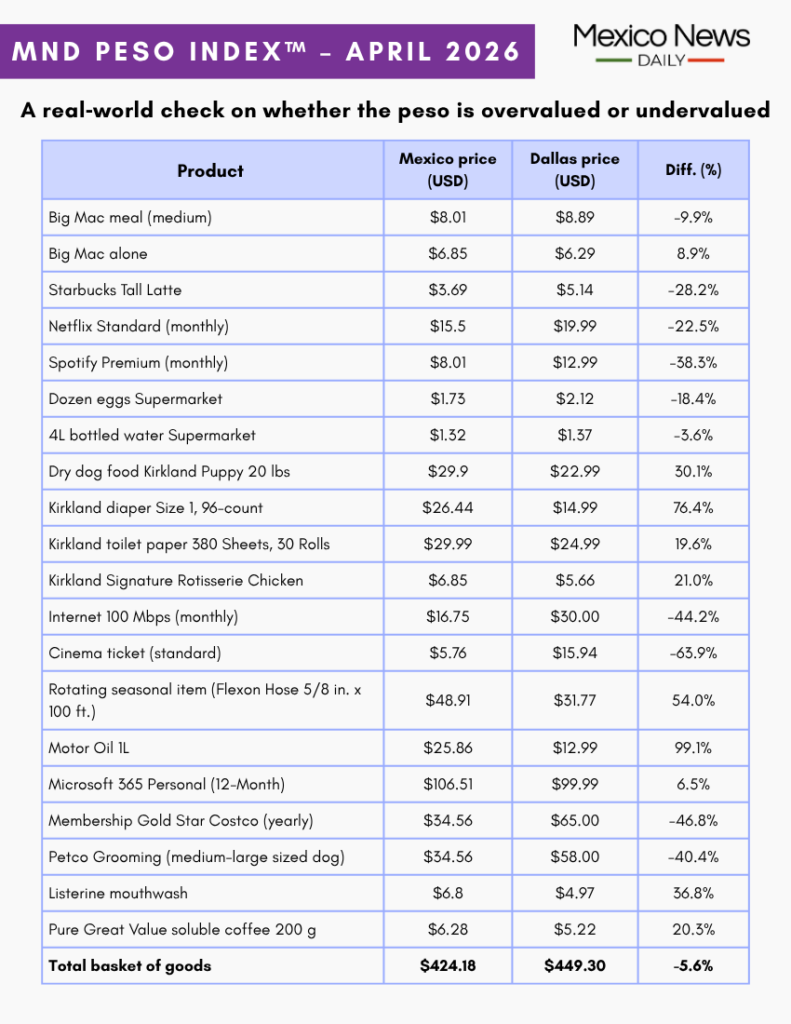
The full breakdown is in the table below.
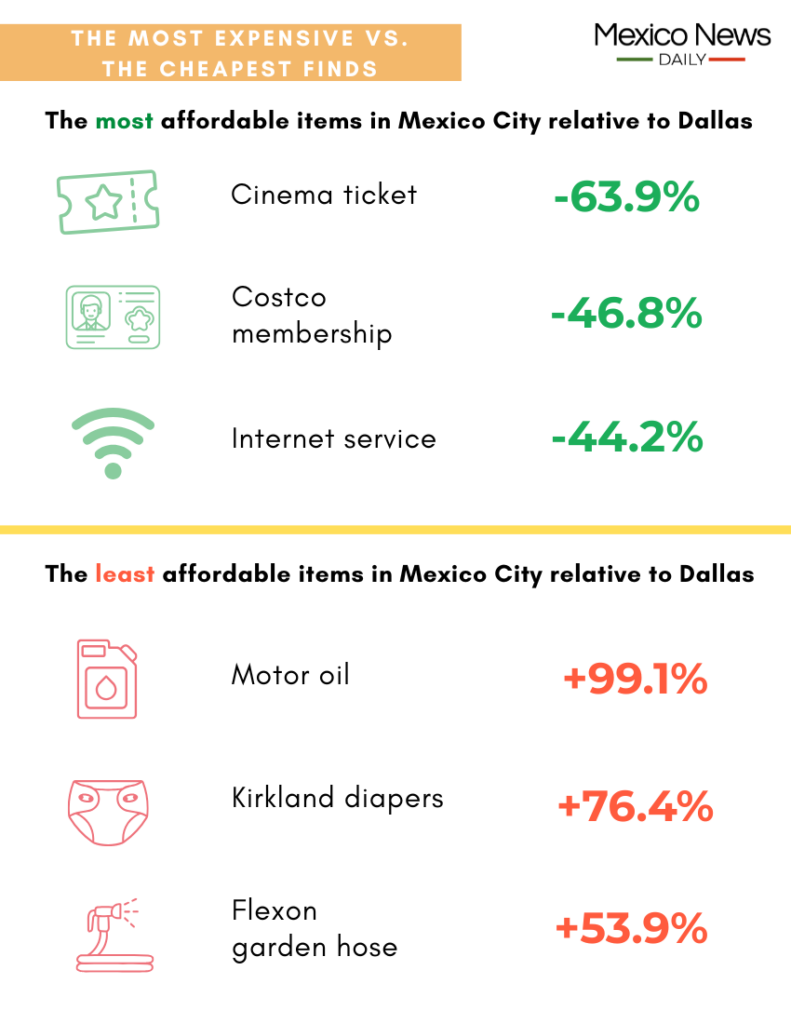
The most affordable items in Mexico relative to Dallas were in services and memberships. The cinema ticket was the cheapest item (-63.9%) relative to Dallas, followed by the Costco Gold Star membership (-46.8%) and internet service (-44.2%) — reflecting Mexico’s comparatively low cost of domestic services. Petco grooming (-40.4%) and Spotify Premium (-38.4%) also came in significantly cheaper in Mexico.
On the other side, branded consumer goods carried the steepest premiums. Castrol motor oil (+99.1%), Kirkland diapers (+76.4%), and the Flexon garden hose (+53.9%) — the seasonal item for April — were the three most expensive items in Mexico relative to Dallas. Listerine mouthwash (+36.8%) and Kirkland dog food (+30.0%) also stood out as notably pricier.
The full basket cost 7,363.83 pesos (US $424.18) in Mexico compared to $449.30 in Dallas — about 5.6% cheaper overall in Mexico. However, this headline figure can be misleading as simple totals are heavily influenced by a handful of high-priced items, which can skew the comparison.
The MND Peso Index™ avoids this distortion by giving each item equal weight. Rather than asking “how much does everything cost in total?”, it asks “at what exchange rate would each item cost the same?” — and then averages those answers. That is why the index shows a 2.83% peso overvaluation even though the raw basket is cheaper in Mexico.
The MND Peso Index™ is not a cost-of-living index: it is a currency valuation tool, designed to measure where the peso should be, not what it costs to live in Mexico.
* Price sources: Mexico prices were collected from the websites and apps of Walmart México, Costco México, AutoZone México, Telmex, Cinépolis, Petco México, and the Mexican outlets of McDonald’s, Starbucks, Netflix, Spotify and Microsoft. Dallas prices were collected from their U.S. equivalents. The Banxico Fix rate of 17.36 published on April 23, 2026 was used as the official exchange rate reference.
Mexico News Daily
The post The MND Peso Index™: Is the Mexican peso over or undervalued against the US dollar? appeared first on Mexico News Daily


Comments
Post a Comment