Mexico’s week in review: A spy scandal and a governor’s indictment put Mexican sovereignty at center stage
The week began where last week left off — with the fallout from the discovery of an unauthorized CIA surveillance operation in Chihuahua. On Monday, Mexico’s Foreign Ministry delivered a formal protest note to U.S. Ambassador Ronald Johnson over the operation, demanding an explanation and asserting that any intelligence activity on Mexican soil requires prior government authorization. By Tuesday, Sheinbaum told reporters that Washington had verbally agreed to respect Mexican law going forward — though she acknowledged no written commitment had been received and that an investigation into the extent of the operation remains open.
That fragile equilibrium was immediately complicated by a new bilateral flashpoint. On Wednesday, the U.S. Department of Justice unsealed an indictment charging Sinaloa Governor Rubén Rocha Moya and nine other state officials with drug trafficking and alleged ties to the Sinaloa Cartel. It was the most direct U.S. action against a sitting Mexican governor in recent memory, and it landed with force on both sides of the border. Sheinbaum responded that Mexico would not extradite Rocha — or any official — without what she called “irrefutable evidence,” reaffirming national sovereignty as the governing principle of her response. In Washington, members of Congress went further: A bipartisan group of U.S. legislators called on Mexico to impeach Rocha and warned of legislative consequences if Mexico failed to act. Mexico’s own opposition parties echoed that demand domestically.
Opposition demands Rocha’s impeachment as US lawmakers escalate pressure on Mexico
All of this unfolded against a backdrop of economic data that told its own complicated story. Mexico’s economy contracted 0.8% in the first quarter of 2026, the first quarterly contraction in three years — even as export revenue surged 27.7% in March, driven by a 43.7% increase in non-automotive manufactured goods including electronics. The contrast underscores the difficult position Mexico finds itself in heading into the summer: strong trade numbers masking underlying economic weakness.
Didn’t have time to catch this week’s top stories? Here’s what you missed.
CIA fallout: A verbal assurance, an open investigation
Mexico’s formal protest over the CIA’s unauthorized operation in Chihuahua marked the first time the government has put its objections in writing to the U.S. ambassador since the operation was disclosed last week. The protest note expressed Mexico’s opposition to U.S. personnel participating in domestic security operations without federal knowledge, and stated that the government expects the incident to be a one-time exception. The following day, Sheinbaum said U.S. officials had privately acknowledged the violation and pledged to comply with Mexican law going forward — but stopped short of saying the matter was resolved. An internal investigation into who in Mexico may have facilitated the operation, and whether the Chihuahua state government had any role, is ongoing.

Sinaloa governor indicted: Mexico pushes back on U.S. pressure
The U.S. indictment of Governor Rocha (a member of the ruling Morena party) and nine Sinaloa state officials on drug trafficking charges set off a rapid chain of political reactions. The timing drew immediate comment: Days after Morena senators accused Chihuahua’s PAN Governor Maru Campos of facilitating the unauthorized CIA operation on Mexican soil, Washington’s legal pressure landed squarely on a Morena-affiliated governor — a sequence that both sides of Mexico’s political divide exploited.
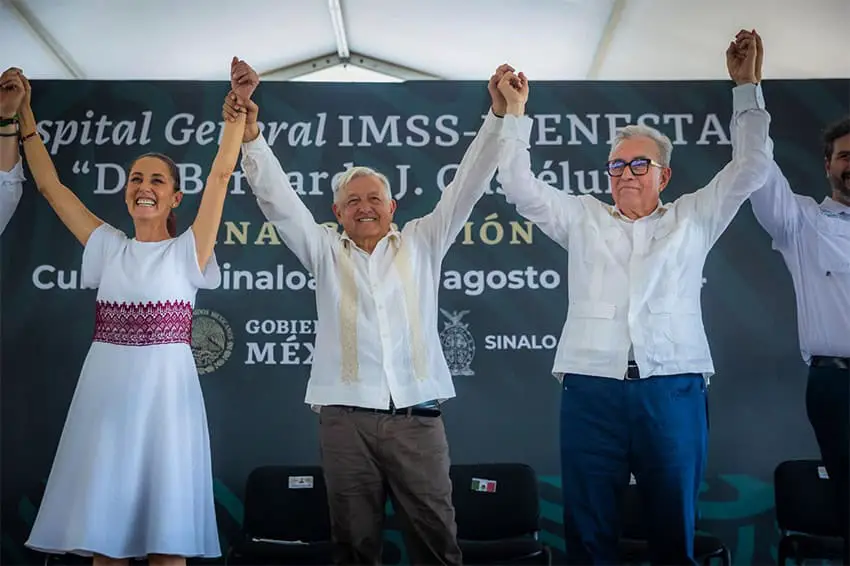
Rocha denied the charges, while Sheinbaum refused to commit to extradition, saying the evidence presented was insufficient under Mexican law and that any next steps would be determined by the FGR’s independent review — not by U.S. pressure. In Washington, the U.S. House Foreign Affairs Committee warned that the indictments are ‘only the beginning’ and vowed accountability for anyone ‘complicit in trafficking drugs into the United States. Mexico’s Citizens’ Movement party and other opposition groups sided with the U.S. position domestically, calling for impeachment proceedings — a demand the ruling Morena bloc has not endorsed.
Navy captures top CJNG commander in Nayarit
In a significant security operation largely overshadowed by the week’s diplomatic turbulence, the Mexican Navy arrested CJNG commander Édgar “El Jardinero” Tabares Murillo in Nayarit state. El Jardinero is allegedly a top operational commanders of the Jalisco New Generation Cartel in the Pacific region, responsible for overseeing drug trafficking routes and cartel territorial control across several states. The arrest was carried out by naval infantry forces and resulted in no military casualties.
Economy: Contraction, export surge and an auto sector warning
Mexico’s GDP shrank 0.8% in the first quarter of 2026 compared to the previous quarter with all three economic sectors — primary, secondary and tertiary — contracting quarter-over-quarter. The headline figure contrasts sharply with trade data: Export revenue rose 27.7% year-on-year in March, with manufacturers of electronics, auto parts and agricultural products all posting double-digit gains.
Separately, new global rankings showed that Mexico has fallen out of the world’s top five vehicle-producing nations for the first time in years, a slide attributed to reduced U.S. demand and plant slowdowns linked to tariff uncertainty. On a more constructive note, Sheinbaum signed a pact Wednesday requiring that all federal public infrastructure projects use Mexican-made steel, a move framed as both an industrial policy measure and a direct response to U.S. tariffs on Mexican metal exports.
Introducing the MND Sheinbaum Index™
Mexico News Daily this week debuted the MND Sheinbaum Index™, a new monthly tracker that measures presidential performance across five weighted categories: economic management, security, sovereignty and foreign relations, social policy, and governance and transparency. Sheinbaum’s inaugural score for March 2026 came in at 60.1 out of 100 — a passing grade, the index notes, but with notable drags from economic indicators and security metrics. The index is designed to offer a data-grounded alternative to purely narrative assessments of the administration’s progress, and will be updated monthly.
World Cup: The squad takes shape, and the city prepares
Mexico’s national football federation released its first batch of World Cup player selections, naming a mix of younger, national players with an eye on ending the country’s long-running round-of-16 elimination streak. The full squad will be finalized in coming weeks. In Mexico City, authorities announced that free fan festivals will be held across all 16 boroughs during the tournament, with outdoor screens, cultural programming and food markets planned for each venue — an effort to ensure the World Cup experience reaches beyond the stadiums.
Travel and tourism developments
The travel industry gathered in Acapulco this week for Tianguis Turístico’s 50th anniversary edition, the country’s flagship tourism trade fair, returning to the Pacific port city in a symbolically significant homecoming given Acapulco’s ongoing post-hurricane recovery. In infrastructure news, Sheinbaum inaugurated the suburban train connecting Mexico City’s downtown rail network with Felipe Ángeles International Airport, addressing one of AIFA’s most persistent criticisms since the airport opened in 2022. Offsetting some of that good news for the tourism sector, Playa del Carmen declared a red alert as an unusually heavy sargassum influx blanketed beaches along the Riviera Maya, with authorities warning of potential economic impact heading into the high season.
Looking ahead
The indictment of the Sinaloa governor, a member of the ruling Morena party, will likely continue to dominate the bilateral agenda with the U.S. in coming weeks. Sheinbaum has framed Mexico’s position clearly — no extradition without formal process and evidence — but U.S. pressure and the threat of legislative retaliation mean the standoff is unlikely to be resolved quickly. Domestically, opposition calls for Rocha’s impeachment will test the unity of the Morena party and its allies. On the CIA front, the investigation into the Chihuahua operation remains open, and any new disclosures about the scope of foreign intelligence activity on Mexican soil could reignite that crisis. With the World Cup now weeks away, the government is also managing the enormous logistical and security demands of hosting a global tournament — including matches in Mexico City, Guadalajara and Monterrey — while navigating one of the most turbulent bilateral moments in recent years.
Also in the news this week
-
Mexico lands 11 bars on North America’s 50 Best list — Including top-ranked entries from Mexico City and Oaxaca, the highest concentration of any country on the list.
-
US $1.2 billion nautical community breaks ground in Nayarit — The marina-anchored development near Nuevo Vallarta marks one of the largest single real estate investments on the Pacific coast in years.
-
Sprawling ancient Maya settlement discovered in Quintana Roo — INAH archaeologists identified the site, named El Jefecino, covering several square kilometers with plazas, platforms and causeways.
-
Zoo animals beat the Mexico City heat with personalized popsicles — As temperatures climbed above seasonal averages, Chapultepec Zoo staff prepared fruit-and-protein frozen treats tailored to each species.
-
Tim Hortons opens its 200th Mexican location in Monterrey — The Canadian coffee chain has grown faster in Mexico than in any other international market, with Monterrey as its latest expansion hub.
Mexico News Daily
This story contains summaries of original Mexico News Daily articles. The summaries were generated by Claude, then revised and fact-checked by a Mexico News Daily staff editor.
The post Mexico’s week in review: A spy scandal and a governor’s indictment put Mexican sovereignty at center stage appeared first on Mexico News Daily


Comments
Post a Comment