How Loreto stood up to the cruise industry and reversed a presidential decree
When a presidential decree opened the UNESCO-designated Loreto Bay National Park to large-scale maritime traffic, residents of the coastal Baja California Sur town were prepared to fight.
The town of Loreto, with a population of around 20,000, has built its identity around low-impact tourism — and a long-running grassroots movement to stop mega cruise ships from entering its protected waters. That changed on April 10, when President Claudia Sheinbaum, with the support of the Mexican Cruise Association, signed a decree reclassifying Loreto as a deep-sea cabotage port, thereby opening it to more and larger vessels.
In the first four months of 2026, Loreto received more than 7,600 cruise ship passengers, up from 1,510 throughout 2025. In addition to the increased pressure on infrastructure, the noise from cruise ships creates a hostile environment for the bay’s native species, such as the endangered blue whale.
Together with fishermen’s cooperatives, tour operators, professional associations and conservation groups — including Conexiones Climáticas, Conserva Loreto and the Unión de Loreto — residents staged major protests, transforming what began as shock and confusion into one of the most rapid environmental campaigns Mexico has seen in years. In just six weeks, Sheinbaum reversed course with a new decree, this one removing the large-scale designation while emphasizing the area’s extraordinary biodiversity and “ecological relevance.”
It also establishes a formal working group — half government representatives, half community and civil society members — to update the park’s management plan and set new rules governing navigation in the bay.
But while residents and environmental advocates are celebrating what many see as a growing wave of environmental pushback in Mexico — including recent setbacks for the massive Saguaro LNG project in the Gulf of California and the “Perfect Day” theme park in Mahahual, Quintana Roo — they also caution that the fight is far from over.
MND Local: A cause to rally behind in Loreto and luxe life in Los Cabos

“The revocation of the decree would only bring us back to the same situation we had before,” wildlife expedition leader and regenerative tourism advocate Regi Domingo said. “For 20 years, cruise ships have still been anchoring irregularly inside the national park. The real challenge now is making sure the management plan finally protects the bay the way the community has been asking for years.”
Moving gently through the sea
For more than a decade, Loreto’s whale guides have been developing what they call “passive whale watching” — a method designed to minimize stress on the animals while allowing visitors intimate encounters with the world’s largest mammals. It’s a method that has been adopted by the Blue Whale Group of Loreto, and the cooperative’s members have shared and improved techniques over the years.
When guides spot the blow of a blue whale in the distance, instructor and naturalist María Nájera explained, they slowly approach to within about 100 meters, then cut the engine and observe the whale’s behavior before moving any closer. Over time, she said, guides began noticing that the whales appeared calmer and more open to the visitors.
“We started to realize the whales were much more relaxed,” Nájera said. “They were feeding more easily at the surface.”
The approach became central to Loreto’s identity as a destination for small-scale ecotourism. Local operators trained one another in the technique, bringing new captains and guides into the practice as whale tourism grew. Many tours limited outings to small groups of six or eight passengers at a time. They were often rewarded with encounters, sometimes surprisingly close.
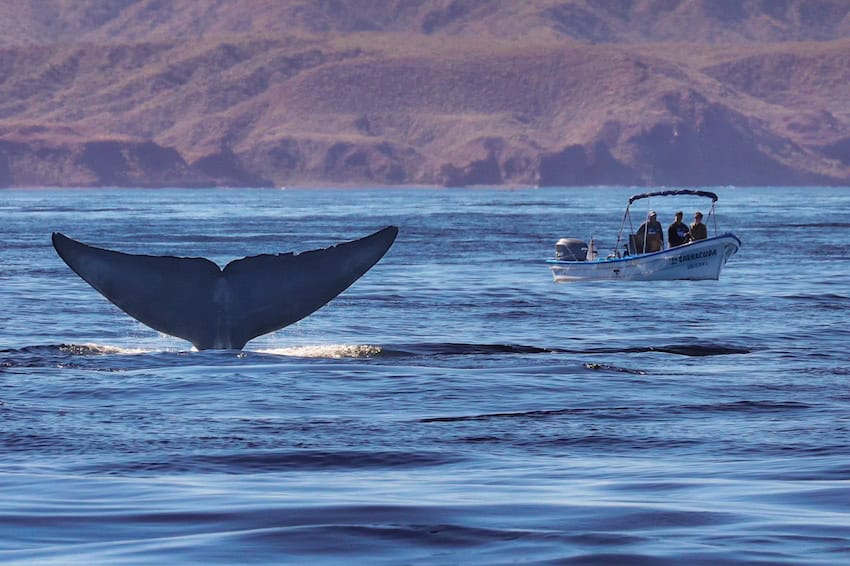
That philosophy stood in sharp contrast to the cruise industry that residents say had already been operating in Loreto for years through legal gray areas, anchoring offshore and ferrying thousands of passengers into the small town in smaller boats.
“When the cruise ship arrives, everything changes,” Nájera said. She described seeing whales become erratic and abandon feeding areas after the arrival of large vessels. In previous years, she said, areas where guides might regularly observe 10 or 12 whales could suddenly fall nearly silent after cruise ship visits.
Pushing back against the tide
Local cooperatives also questioned the economic benefits the ships brought to the town.
Noé Gaona, president of the Union of Cooperatives of Loreto, said most cruise passengers spent little money locally because food and entertainment were already included onboard. Local guides and fishermen, he said, often felt displaced rather than included in the business model, with contracts concentrated among a small number of operators.
“We felt we were being pushed aside,” Gaona said.
Gaona recalled learning about the decree during one of the cooperative union’s organizing meetings. At first, he said, many residents feared speaking publicly against the project, worried there could be repercussions for permits or future work.
But when organizers called a public meeting in a local park to explain the decree and gather signatures, more than 300 people showed up — far more than expected.
“We realized people really wanted to speak,” Gaona said.
Soon afterward, they organized a noisy caravan through town, with residents decorating vehicles with signs and honking in protest. Then, when what organizers believed would be the season’s final cruise ship arrived, hundreds gathered peacefully near the marina carrying banners and signs, while many local tourism operators refused to work that day.
Families came with children. Some residents tried to confront cruise passengers more aggressively, Gaona said, but organizers intervened to keep the demonstration calm.
“We wanted people to understand what was happening without turning it into an attack,” he said.
Gaona said what stayed with him most was not the confrontation itself, but the unity that emerged across the town.
“It was a genuine movement — a movement that no one expected,” he said. “And it was something that surprised me: seeing the unity that emerged amidst everything triggered by this decree. It filled me with pride to hear the mothers, the children, the students and the older people — those who understood the problem and wanted to help. I am proud to say that we proved ourselves to be an intelligent people, but a peaceful one as well.”
Could Loreto set a precedent for the Baja California peninsula?
Environmental advocates say Loreto’s victory may ultimately carry significance far beyond the Baja California Sur town.
Roberto Cerda, a Gulf of California conservation advocate who has worked on marine protection issues across Mexico’s Pacific coast, said Loreto is only one front in a growing regional struggle.
“What we are seeing is not an isolated conflict in Loreto,” Cerda said. “Across the Gulf of California, there are simultaneous efforts tied to LNG infrastructure, shipping routes, industrial tourism and even deep-sea mining proposals. What worries many of us is what feels like a systematic effort to weaken the legal protections that already exist for some of the most biologically important marine regions in Mexico.”
Just across the Gulf in Topolobampo, Sinaloa, for example, construction of a controversial ammonia plant inside a designated Ramsar wetlands reserve continues despite strong backlash from the local community.
For now, however, many residents are allowing themselves a moment of cautious relief.
The repeal decree opens a new phase centered on updating the management plan for Loreto Bay National Park — a process activists hope will permanently strengthen restrictions on large-scale maritime traffic and industrial activity inside the protected area. In order to succeed, Domingo says the working group must bring together science, local knowledge and authorities to address current and emerging pressures, particularly deep-sea navigation, “and ensure the program is fully implemented, not just written, with real monitoring, inspections and enforcement.”
But as Cerda and Domingo point out, Loreto is just one part of a highly intricate and interdependent web of life.
“We need to be able to protect the entire Gulf of California as an ecosystem that is all connected,” Domingo said. “It is a corridor for highly migratory species and also for resident species that depend entirely on these ecosystems. Now the decree has been revoked for Loreto, but the work continues. We cannot feel fully happy and ensure these species, ecosystem and community are protected if the other places they pass through are still under pressure.”
Tracy L. Barnett is a Guadalajara-based freelance writer and the founder of The Esperanza Project.
The post How Loreto stood up to the cruise industry and reversed a presidential decree appeared first on Mexico News Daily


Comments
Post a Comment